

Challenge Overview: The Nerv System simulation was exhausted by an advanced attack. We were provided with forensic artifacts collected by the Magi System (UAC — Unix Artifact Collector). Our goal was to identify the specific processes causing the exhaustion, the network infrastructure involved, the persistence mechanism, and the threat actor responsible.
Final Flag
nexus{3106549_5.178.96.15_3106565_196.251.73.38_T1543.002_diicot_ElPatrono1337}Step 1: Scoping the Incident (Finding the “Exhaustion”)#
The challenge stated that the system was “exhausted.” In Linux forensics, this typically points to a process consuming excessive CPU or memory. We began by analyzing the process listing.
- File Analyzed:
collected/live_response/process/ps_auxwwwf.txt - Command:
cat collected/live_response/process/ps_auxwwwf.txt

Finding: We located a suspicious process running as user nexus with abnormally high CPU usage (199%) and a randomized binary name, which is characteristic of crypto-miners.
USER      PID    %CPU %MEM    VSZ     RSS  TTY STAT START    TIME COMMAND
nexus  3106565   199  14.6  2441708 2405028 ?  Ssl  Oct11 6489:10 ./293853dc
PID 2 Identified: 3106565 (The Miner)
Step 2: Tracing the Infection Chain (Finding the Loader)#
Malware rarely runs alone; a loader or watchdog process typically keeps the payload alive. Looking directly above the miner in the process tree (ps_auxwwwf.txt), we found its parent.
Finding: Immediately preceding the miner was a process named cache.
nexus  3106549  0.0  0.0 1227108 3544 ?  Sl  Oct11   0:01 cache
                                                            \_ ./293853dc
PID 1 Identified: 3106549 (The Loader)
Step 3: Network Forensics (Mapping the Infrastructure)#
We needed to find the IP addresses associated with these two PIDs by correlating them against the network connection logs.
- File Analyzed:
collected/live_response/network/netstat_-anp.txt - Commands:
grep "3106549" ...andgrep "3106565" ...
Finding 1 — Loader Connection: The Loader (cache) was actively connected to a Command and Control (C2) server on a non-standard SSH port (222).
tcp 0 0 82.29.168.70:48502 5.178.96.15:222 ESTABLISHED 3106549/cacheIP 1 Identified: 5.178.96.15
Finding 2 — Miner Connection: The Miner (./293853dc) was connected to a known mining pool port (7777).
tcp 0 0 82.29.168.70:50572 196.251.73.38:7777 ESTABLISHED 3106565/./293853dcIP 2 Identified: 196.251.73.38

Step 4: Identifying Persistence (MITRE ATT&CK)#
We needed to determine how the malware survived reboots. While cron was running on the system, a closer look at the process tree revealed a specific execution context for the user nexus.
- File Analyzed:
collected/live_response/process/ps_auxwwwf.txt
Finding: The malware chain was running under a Systemd User Instance.
nexus 3099017 0.0 0.0 20160 11392 ? Ts Oct11 0:00 /usr/lib/systemd/systemd --userThe malware likely created a malicious .service file (e.g., in ~/.config/systemd/user/) to ensure it auto-starts when the user’s session is spawned or on boot. This technique maps to T1543.002 (Create or Modify System Process: Systemd Service).

MITRE ID Identified: T1543.002
Step 5: Attribution (Actor and Fingerprint)#
Finally, we needed to attribute the attack to a specific group and find the unique SSH fingerprint.
1. Threat Actor Name#
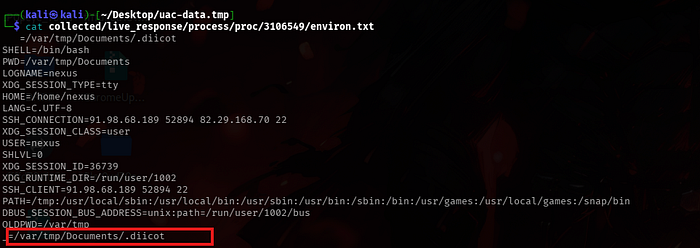
We inspected the environment variables of the Loader process (PID 3106549) to look for hidden variables or file paths.
- File Analyzed:
collected/live_response/process/proc/3106549/environ.txt
Finding:
_=/var/tmp/Documents/.diicotThe presence of the hidden artifact .diicot confirms the actor is the Diicot group — a Romanian crypto-jacking threat group also associated with the Kinsing malware family.
Actor Identified: diicot
Reference: Tracking Diicot: An Emerging Romanian Threat Actor — Darktrace
2. SSH Fingerprint#
The Diicot group is known for leaving specific signatures in the authorized_keys files they modify. Cross-referencing OSINT and CTI reporting on this group:
Reference: Tracking Diicot: An Emerging Romanian Threat Actor — Darktrace
Fingerprint Identified: ElPatrono1337